Puzzle Fern
NUMBER LOGIC · CORE DEDUCTIONS
Sudoku Strategies: From Naked Singles to X-Wing & Swordfish
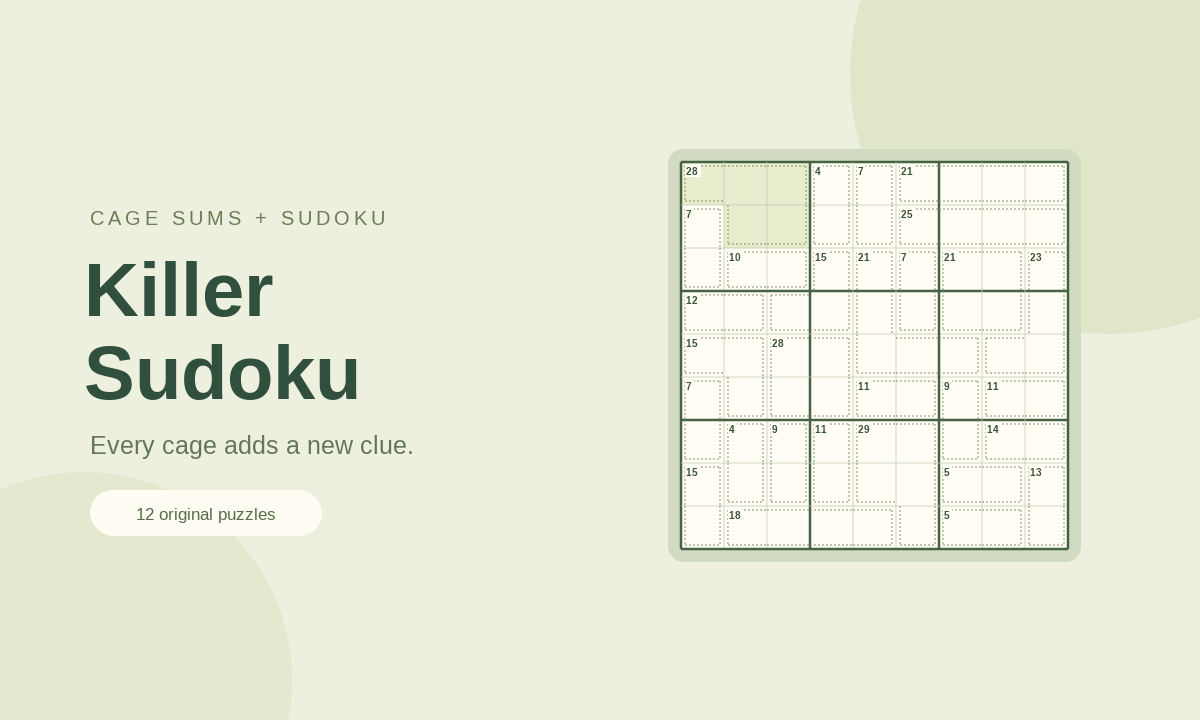
Every well-formed number grid—from classic 9×9 Sudoku to Killer Sudoku, Suguru, and Futoshiki—has a single unique solution reachable through pure logical elimination without guessing. Originally published as Number Place by retired Indiana architect Howard Garns in the May 1979 issue of Dell Pencil Puzzles and Word Games and named Sudoku ("single digits") by Maki Kaji at Japanese puzzle publisher Nikoli Co. in 1984, standard grids obey one Latin-square invariant proved by McGuire, Tugemann & Civario (2014, arXiv:1201.0749): a uniquely solvable 9×9 Sudoku requires at least 17 given clues (16 clues never determine a unique solution across all 6,670,903,752,021,072,936,960 valid grids).
Complete Hierarchy of 8 Deterministic Sudoku Strategies
Work down this ladder in order. Whenever an advanced step deletes even a single pencil mark, drop right back to Tier 1 to harvest newly exposed singles:
| Tier & Strategy | Unit Scope | Trigger Pattern | Exact Elimination Rule |
|---|---|---|---|
| 1. Naked Single | 1 cell | 8 digits already appear across the cell's row, column, and 3×3 box |
Place the sole surviving candidate digit immediately |
| 2. Hidden Single | 1 row, col, or box | Candidate digit d appears in only 1 cell of that 9-cell house |
Place d in that cell even if 3–5 other pencil marks remain there |
| 3. Pointing Pair / Triple | Box → Row/Col | Inside one 3×3 box, all candidates for digit d align on a single row or column |
Erase d from the other 6 cells of that row or column outside the box |
| 4. Box-Line Reduction | Row/Col → Box | Along one row or column, all spots for digit d fall inside a single 3×3 box |
Erase d from the other 6 cells of that 3×3 box |
| 5. Naked Pair / Triple | 2 or 3 cells in 1 house | Two cells hold only {4,7} (or three cells hold subsets of {2,5,8}) |
Erase those 2 (or 3) digits from all other 7 (or 6) cells in the shared house |
| 6. Hidden Pair | 2 cells in 1 house | Digits {3,9} appear nowhere else in the house except the exact same 2 cells |
Strip all other pencil marks out of those 2 cells, leaving pure {3,9} |
| 7. X-Wing (2×2 Fish) | 2 rows × 2 cols | Digit d has only 2 positions in Row A and the same 2 columns in Row B |
Diagonal corners must hold two ds—erase d from all other cells in both columns! |
| 8. Y-Wing (XY-Wing) | Pivot + 2 pincers | Pivot {X,Y} sees Pincer 1 {X,Z} and Pincer 2 {Y,Z} |
Whether Pivot = X or Y, one pincer becomes Z—erase Z from every cell seeing both pincers! |
Why Locked Candidates Solve 70% of Medium-to-Hard Grids
Players transitioning from beginner boards to Killer Sudoku or Skyscrapers most often stall because they scan only for placements rather than intersection locks. Every 3×3 box shares exactly 3 cells with each intersecting row or column:
- Worked Pointing Pair Example: Suppose Box 1 (top-left) already contains
1, 2, 5, 6, 8, 9, and digit4is blocked from Row 2 and Row 3 inside Box 1—leaving onlyr1c1andr1c3as legal homes for4inside Box 1. Even before knowing which of those two cells holds4, Row 1's4is 100% claimed by Box 1. You can immediately cross4offr1c4throughr1c9! - Snyder Notation Discipline: Popularized by World Sudoku Champion Thomas Snyder, write a corner pencil mark inside a
3×3box only when a digit has exactly 2 possible cells in that box. The instant a second digit occupies the exact same two cells, a Hidden Pair flashes visually with zero clutter; if a placement overwrites one of the two marks, the twin resolves on sight.
Spotting X-Wing & Swordfish Without Trial-and-Error
Fish patterns generalize Pigeonhole Parity across parallel lines without guessing:
- X-Wing (Order-2 Fish): Filter one single digit (say
7). If Row 2 restricts7to Columns3and8, and Row 7 also restricts7to Columns3and8, those four intersections (r2c3, r2c8, r7c3, r7c8) form a sealed rectangle. Eitherr2c3 + r7c8 = 7orr2c8 + r7c3 = 7. Every other cell in Column 3 and Column 8 loses candidate7! - Swordfish (Order-3 Fish): Three rows each confine digit
dto two or three cells lying inside the exact same union of three columns (for instance Columns1, 5, 9). Those three rows supply all three required copies ofdfor Columns1, 5, 9—eliminatingdfrom the remaining 18 cells of those three columns.
Transfer These Exact Skills Across Puzzle Fern Number Boards
Ready to apply candidate locking and sum constraints live? Try Killer Sudoku Online (paired with our Killer Sudoku Cage Combinations Cheat Sheet), Kakuro Cross-Sums, Futoshiki Inequality Grids, Suguru Region Tectonics, or non-touching placement in CatDoku.