Puzzle Fern
ARITHMETIC CROSSWORDS · REFERENCE
Kakuro Cheat Sheet: Cross-Sum Combinations & Intersection Strategy
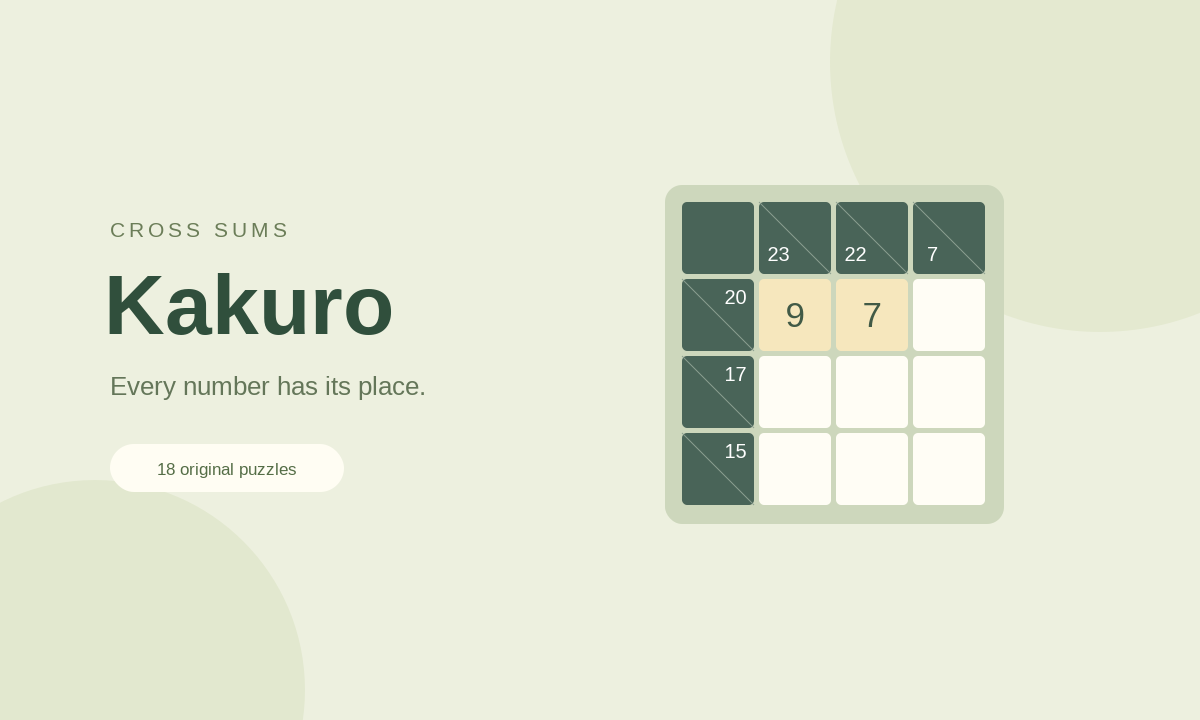
Kakuro—invented in 1950/1966 by Canadian constructor Jacob E. Funk as Cross Sums in New York's Dell Magazines and popularized in Japan in 1986 by Maki Kaji at Nikoli Co. (from kasan kurosu, "addition cross")—functions like a mathematical crossword. Every horizontal or vertical run of white cells must add up to its black-triangle clue using digits 1–9 with no repeated digit inside the same run.
How Kakuro Differs From Killer Sudoku
Unlike Killer Sudoku, Kakuro has no full-row 1–9 rule and no 3×3 boxes: the exact same digit can reappear in the same row or column as long as a black clue block separates the two runs! Instead, 100% of Kakuro deductions come from perpendicular cell intersections— proven NP-complete for general grids by Seta (2002, University of Tokyo) yet rapid for humans armed with unique partitions.
Essential Kakuro Unique Combinations Table (2 to 7 Cells)
Memorize the 2-cell and 3-cell extremes first; they anchor almost every opening move on Kakuro Online:
| Run Length | Minimum Sums (Forced Low Digits) | Maximum Sums (Forced High Digits) | Min–Max Sum Range |
|---|---|---|---|
| 2 squares | 3 = 1+2 · 4 = 1+3 | 16 = 7+9 · 17 = 8+9 | 3 to 17 |
| 3 squares | 6 = 1+2+3 · 7 = 1+2+4 | 23 = 6+8+9 · 24 = 7+8+9 | 6 to 24 |
| 4 squares | 10 = 1+2+3+4 · 11 = 1+2+3+5 | 29 = 5+7+8+9 · 30 = 6+7+8+9 | 10 to 30 |
| 5 squares | 15 = 1..5 · 16 = 1+2+3+4+6 | 34 = 4+6+7+8+9 · 35 = 5..9 | 15 to 35 |
| 6 squares | 21 = 1..6 · 22 = 1+2+3+4+5+7 | 38 = 3+5+6+7+8+9 · 39 = 4..9 | 21 to 39 |
| 7 squares | 28 = 1..7 · 29 = 1+2+3+4+5+6+8 | 41 = 2+4+5+6+7+8+9 · 42 = 3..9 | 28 to 42 |
4-Cell Near-Unique Runs Worth Spotting Instantly
- 12 in 4 cells (2 ways):
1+2+3+6or1+2+4+5→ Digits1and2are guaranteed in the run, and no cell can exceed6! - 13 in 4 cells (3 ways):
1+2+3+7,1+2+4+6,1+3+4+5→ Digit1is guaranteed, max digit is7. - 27 in 4 cells (3 ways):
3+7+8+9,4+6+8+9,5+6+7+9→ Digit9is guaranteed, min digit is3. - 28 in 4 cells (2 ways):
4+7+8+9or5+6+8+9→ Digits8and9are guaranteed, min digit is4!
Worked Cross-Run Intersection Walkthrough
Suppose a single white square sits at the crossroads of a Horizontal 16 in 2 cells and a Vertical 23 in 3 cells:
- Horizontal
16in 2 cells has only one partition:{7, 9}. - Vertical
23in 3 cells has only one partition:{6, 8, 9}. - Take the set intersection:
{7, 9} ∩ {6, 8, 9} = {9}! That crossing square must be9, which immediately forces its horizontal partner to be16 - 9 = 7and leaves{6, 8}for the remaining two vertical squares!
Even non-unique clues collapse at intersections: if a 2-cell 7 ({1..6} max 6) crosses a 2-cell 15 ({6,9} or {7,8}, min 6), only 6 fits both ranges—solving all three squares in one stroke! Practice live right now on Kakuro Online or try dock-sum merging in Sum Docks.