Puzzle Fern
PICTURE LOGIC · STEP-BY-STEP
How to Solve Nonograms (Picross): Overlap Formula, Edge Pull & Crosses
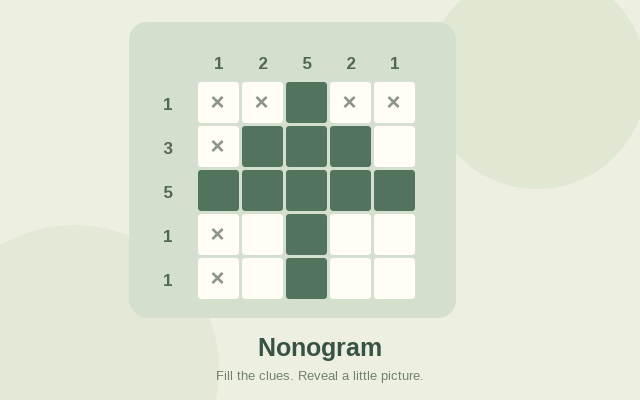
Learning how to solve Nonograms (also published as Picross, Griddlers, Paint by Numbers, and Hanjie) turns intimidating blank grids into crisp visual deductions. Independently created in 1987 by Japanese graphics editor Non Ishida (who won a Tokyo skyscraper window-light design competition) and puzzle designer Tetsuya Nishio—and introduced globally via London's Sunday Telegraph by James Dalgety in 1990—general Nonograms were proved NP-complete by Ueda & Nagao (1996, IEICE Trans. Inf. & Syst.), yet human-crafted boards on Nonogram Online yield smoothly to five deterministic rules.
Rule 1: The Exact Mathematical Overlap Formula (Simple Boxes)
On a line of length N with clue numbers c1, c2, ..., cm, adjacent shaded runs must be separated by at least 1 empty square (×). Define the minimum span required by all clues as:
S = (c1 + c2 + ... + cm) + (m - 1), and slack Δ = N - S.
Any single clue k strictly greater than slack (k > Δ) MUST overlap itself in the center by k - Δ guaranteed shaded squares, regardless of how far left or right the blocks slide!
Grid Width (N) |
Row / Column Clue | Min Span (S) & Slack (Δ) |
Guaranteed Shaded Cells on Turn 1 |
|---|---|---|---|
10×10 (N = 10) | 10 | S = 10, Δ = 0 | All 10 cells shaded immediately |
10×10 (N = 10) | 7 | S = 7, Δ = 3 | Middle 4 cells (c4, c5, c6, c7) shaded (7 - 3 = 4) |
10×10 (N = 10) | 4 5 | S = 4+5+1 = 10, Δ = 0 | Exact pack! ■ ■ ■ ■ × ■ ■ ■ ■ ■ (all 10 cells solved!) |
10×10 (N = 10) | 3 5 | S = 3+5+1 = 9, Δ = 1 | 3 - 1 = 2 cells from first block (c2,c3) + 5 - 1 = 4 from second (c6..c9) |
15×15 (N = 15) | 9 | S = 9, Δ = 6 | Middle 3 cells (c7, c8, c9) shaded (9 - 6 = 3) |
15×15 (N = 15) | 2 8 2 | S = 12+2 = 14, Δ = 1 | 1 cell of each 2 + 7 cells of the middle 8! |
Rule 2: Always Mark Empty Squares With × Crosses
Beginners stall because they leave confirmed empty squares blank instead of placing an explicit × cross. Placing crosses shrinks the effective line length N and triggers three rapid chain reactions:
- Line Completion Cross-Out: The moment a clue line has all its required runs placed, fill every remaining blank square in that row or column with
×—instantly walling off perpendicular columns! - Too-Tight Gap Elimination: If your smallest remaining clue in a row is
4and two crosses trap a2-cell or3-cell pocket, cross out that entire pocket (× × ×) immediately! - Reachability Pruning: If a known single run of length
4already has cellc5shaded, cellsc1andc9..c10are mathematically out of reach—mark them×!
Rule 3: Edge Pull & "Mercury" Bounce
- Anchored Edge Extension: Whenever cell
c1(the left/top border) is shaded on a row whose first clue is5, the run has nowhere to expand leftward—immediately shadec1..c5and capc6with an×! - Mercury Bounce Off a Near-Border Fill: Suppose a row starts with clue
4and cellc2is already shaded whilec1is still unknown. Even if the4-run starts atc1, it reachesc4; if it starts atc2, it reachesc5—so cellsc3andc4are guaranteed shaded! Conversely, ifc5were later marked×, the4-run bounces backward intoc1.
Test Any Board Step-by-Step in Our Interactive Solver
Play handcrafted 5×5, 10×10, and 15×15 boards with multi-step Undo on Nonogram Online—or paste clues from any external Picross puzzle into our Step-by-Step Nonogram Solver to see one human-explained deduction at a time!