Puzzle Fern
BOARD CLASSICS · EXACT WALKTHROUGH
Peg Solitaire Solution: Verified 31-Jump Center Finish & Parity Invariant
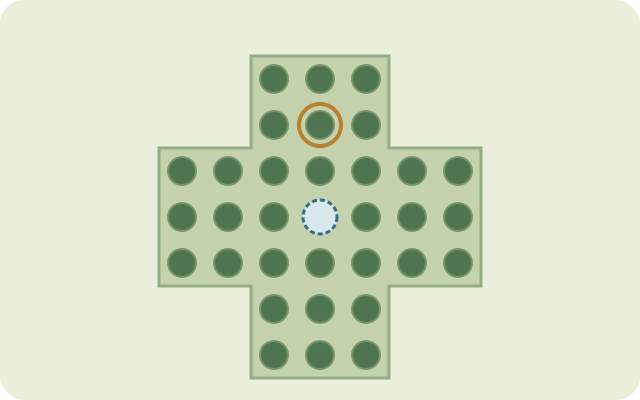
Starting with 32 pegs and an empty center hole (d4) on the classic 33-hole English cross board, every jump removes exactly one jumped peg—meaning any complete Peg Solitaire win takes exactly 31 single jumps. Documented at the court of Louis XIV in 1697, analyzed algebraically by Gottfried Wilhelm Leibniz (1716), and minimized to a world-record 18 multi-jump sweeps by Ernest Bergholt in 1912 (proved shortest possible by John Beasley, 1964), Peg Solitaire hides elegant finite-group mathematics beneath its simple wooden pegs.
Why Random Jumping Leaves Stranded Edge Pegs (Conway's Rule of Three)
In Indagationes Mathematicae (N. G. de Bruijn, 1972) and Berlekamp, Conway & Guy's classic Winning Ways for Your Mathematical Plays (Vol. 2, Academic Press, 1982), mathematicians label board diagonals with three Klein four-group symbols (α, β, γ) so that jumping two adjacent pegs replaces their pair with the third symbol—leaving the total XOR sum invariant throughout the entire game! Two practical consequences immediately guide your play on Peg Solitaire Online:
- Only 5 Legal Final Holes Exist From a Center-Empty Start: When hole
d4starts empty, group parity proves the final surviving peg can land only on the dead centerd4or one of the four mid-edge holes three steps away (d1,a4,g4,d7)! Trying to finish onc3ore4is mathematically impossible. - Clear the Four 3×2 Wing Arms Before Touching Your Spine: Never empty the central
3×3crossroads early—once the center goes hollow, pegs trapped on opposite arms cannot jump across the chasm!
Complete Machine-Verified 31-Jump Solution (Final Peg in Center d4)
Columns run a–g left-to-right and rows run 1–7 top-to-bottom (so the top 3-hole edge is c1, d1, e1 and the center hole is d4). Every single move below has been verified step-by-step on our exact 7×7 Peg Solitaire Online engine:
| Phase | Jump Numbers & Coordinates (From → To) |
Board Milestone |
|---|---|---|
| Moves 1–8 (Top & Left Wing Opening) | 1. d2→d4 · 2. b3→d3 · 3. c1→c3 · 4. e1→c1 · 5. d3→b3 · 6. a3→c3 · 7. e3→e1 · 8. g3→e3 |
Clears top ridge d1 and upper wing corners cleanly |
| Moves 9–16 (East–West Flank Purge) | 9. c4→c2 · 10. c1→c3 · 11. a4→c4 · 12. c4→c2 · 13. e4→e2 · 14. e1→e3 · 15. g4→e4 · 16. e4→e2 |
Top arm & upper flanks completely evacuated! |
| Moves 17–24 (Lower-Left & Right Arms) | 17. c6→c4 · 18. a5→c5 · 19. c5→c3 · 20. c2→c4 · 21. c4→e4 · 22. e5→e3 · 23. e2→e4 · 24. g5→e5 |
Left, top, and right arms 100% empty—8 pegs left! |
| Moves 25–31 (Southern Endgame Sweep) | 25. d5→f5 · 26. e7→e5 · 27. e4→e6 · 28. c7→e7 · 29. e7→e5 · 30. f5→d5 · 31. d6→d4 |
1 peg remaining dead-center at d4! |
How to Remember Solutions Without Memorizing 31 Coordinates: Six-Peg & Three-Peg Packages
Rather than memorizing individual coordinates, Conway and Beasley group pegs into self-canceling packages using one nearby "catalyst" peg that jumps out and jumps right back to its original hole:
- 3-in-a-Row Catalyst Purge: Whenever a catalyst peg sits perpendicular to the middle of three consecutive pegs (with an empty hole beyond), the catalyst jumps across the middle peg, one outer peg jumps the other into the vacated spot, and the catalyst jumps back—erasing 3 pegs in a straight line while leaving the rest of the board unchanged!
- L-Package (6-Peg Wing Clear): Clearing each outer
2×3wing arm as two parallel 3-peg packages leaves the iconic 7-peg House / Cross endgame in the central square, which folds cleanly intod4.
Open Peg Solitaire Online right now to test both short endgame warmups and the full 33-hole cross board with unlimited Undo—or explore all six strategy guides in our Puzzle Strategy Library!